
Key findings
- The LLE creates a more portable, credit-based finance framework for eligible level 4–6 learning, but adult participation will still depend on whether study is understandable, affordable in practice and compatible with work and care.
- The early modular market is intentionally selective. Approved provision, standardised transcripts and regulatory safeguards may support quality and transferability, but they do not guarantee a locally accessible or well-timetabled choice of modules.
- The strongest evidence on adult learning points to non-financial constraints—especially work and family time pressures—as persistent barriers. Loans cannot themselves create protected study time, predictable rotas or employer support.
- The appropriate launch measures are conversion and progression measures: from enquiry to enrolment, module to recognised credit, and learning to credible work, enterprise or productivity benefits.
- Providers, employers and local partners should treat advice, timetabling, credit recognition, transcripts and progression routes as one learner journey rather than separate operational tasks.
The LLE’s first test is whether adults can make a viable decision
**Evidence.** The Department for Education (DfE) says applications for Lifelong Learning Entitlement (LLE) funding will open in late October 2026 for eligible courses and modules starting on or after 1 January 2027. The tuition-fee entitlement can be worth up to £39,160 for eligible learners, broadly equivalent to four years of full-time study at the maximum fee level for 2026–27. Maintenance support may also be available for qualifying courses with in-person attendance (Department for Education, 2026) ↗ ↗.
The reform matters because it seeks to make eligible higher-level learning more portable across a working life. It is designed around courses, modules and accumulated credit rather than a single, conventional full-time study episode. That is a material shift for England at a time when employers, small businesses and public services face continuing pressure to renew technical, managerial and digital capability.
But the policy’s operational milestone should not be mistaken for its public value. A functioning application system and available loans are necessary conditions; they are not evidence that an adult can make a good learning choice. A prospective learner must still establish whether a course is relevant, whether attendance is compatible with shifts or caring, what a module leads to, what support is available, and whether the likely return justifies the time and debt involved.
This is especially important in an England-specific policy landscape. The DfE distinguishes between eligibility for qualifying full courses across the UK and LLE-funded modular provision, which is restricted to providers operating within the English regulatory system (Department for Education, 2026) ↗. Local communications that present the LLE as a uniform UK-wide modular offer risk creating avoidable confusion.
**Interpretation.** The central implementation risk is therefore navigational rather than purely financial. Adults do not encounter the LLE as a policy architecture; they encounter it as a sequence of practical decisions under constraints. If those decisions require specialist knowledge, repeated searching or confidence in higher education systems, flexibility may be most usable by people who already have the resources to navigate it.
**Sanctuary recommendation.** Before applications open, local partnerships should publish learner-facing pathway maps for priority sectors and occupations. Each route should identify entry requirements, delivery pattern, credit volume, likely next steps, support arrangements and the practical implications of attendance. The test is not whether information exists somewhere online; it is whether a person can understand a credible route without needing to become an expert in student finance.
Selective modularity protects quality—but limits immediate choice
**Evidence.** Modular funding will not apply to every short course or provider at launch. Eligible provision includes higher technical qualifications without subject restrictions and selected level 4–6 modules drawn from full level 6 qualifications aligned with priority skills needs and the industrial strategy. Providers must be approved through the relevant process and registered with the Office for Students (OfS) to deliver funded modules (Department for Education, 2026) ↗. A further expression-of-interest round, opening in October 2026, is intended to support provision beginning from September 2027 (Department for Education, 2026) ↗.
The OfS states that its existing registration conditions, data requirements and monitoring approach will generally continue to apply to LLE-funded higher education and modular provision (Office for Students, 2026) ↗. The DfE also requires standardised transcripts for modules designated for funding, providing a common record of learning and credit (Department for Education, 2026) ↗.
**Interpretation.** This is a defensible design. A rapid expansion of loosely connected short courses could leave learners with credit of uncertain standing and employers with little basis for interpreting it. Approval, regulation and standardised transcripts can make modular study more legible and protect against a market in disconnected provision.
The trade-off is that the initial offer is likely to be narrower than the language of flexibility can imply. An approved module is not automatically an accessible option. It may be geographically distant, offered at an unsuitable time, reliant on digital access a learner does not have, or difficult to combine with the next module or qualification they need. Availability must also be understood locally: an online option can widen reach, but may not resolve the need for practical facilities, teaching contact or a predictable assessment schedule.
For local economies, this matters more than a count of funded modules. SMEs, high-street businesses and social enterprises are unlikely to gain much from nominal choice if staff cannot identify short, credible routes that fit operational demand. Equally, employers may be reluctant to release people for learning where the relationship between a module, a recognised qualification and workplace capability is unclear.
**Sanctuary recommendation.** Providers should present each funded module as part of a published progression route, not as a standalone catalogue entry. At minimum, learners should be able to see the parent qualification, credit and transcript arrangements, opportunities to accumulate credit, likely next modules, weekly study commitment, attendance expectations, assessment timing and a route to advice on recognition of prior learning. A more meaningful launch metric than modules advertised is the proportion of modules with a published, adviser-supported progression route.
Finance lowers one barrier; it does not remove the participation problem
**Evidence.** The best available evidence on adult learning cautions against treating cost as the sole obstacle. The OECD reports that, across participating countries and economies, 48% of adults who faced barriers identified work or family time constraints as their most important obstacle to participation (OECD, 2025) ↗. A systematic review covering 74 peer-reviewed studies published between 2000 and 2025 similarly identifies work–study conflict, time constraints and financial pressures as recurrent barriers. It finds flexible provision and institutional support to be increasingly important enablers (Park and Su, 2026) ↗.
The review does not evaluate the LLE or the English system specifically, and its international evidence should not be treated as a forecast of English take-up. It also did not undertake a formal risk-of-bias appraisal. Its value here is conceptual rather than predictive: adult participation is shaped by the interaction between personal circumstances and institutional design, not by motivation alone (Park and Su, 2026) ↗.
**Interpretation.** The LLE addresses a genuine financing and portability problem. It cannot itself create affordable childcare, control a shift rota, reduce travel time or secure permission from an employer to attend. Nor does a tuition-fee loan remove an adult’s judgement about repayment, lost income, household risk and the credibility of employment returns.
This creates an equity risk. If the earliest users are predominantly people with stable work, flexible managers, prior experience of higher education and confidence in digital systems, the LLE may widen formal choice without substantially widening participation. That would still produce funded learning, but it would fall short of the policy’s wider promise of flexibility across working lives.
The mechanism is practical. A learner may value a course and qualify for finance, yet abandon the decision because assessment dates collide with peak trading, evening classes conflict with care, or no one can explain whether 30 credits will count towards a useful destination. These are not marginal administrative issues. They are the points at which an entitlement becomes usable or remains theoretical.
**Sanctuary recommendation.** Recruitment and support should be organised around constraints rather than broad demographic categories alone. Shift workers may need predictable asynchronous activity and assessment windows; carers may need clustered attendance; people returning to learning may need confidence-building academic support; and employees may benefit from a simple written agreement on study time and workplace expectations. For employers, especially smaller firms, a clear explanation of the capability and progression value of a module is more persuasive than generic appeals to lifelong learning.
Judge the launch by usable progression, not funded activity
**Evidence.** Applicants will need to make a new LLE application for each course or module they seek to fund. Those who already have a Student Finance England account will still need to create a new account for LLE funding (Department for Education, 2026) ↗. This may be appropriate for recording distinct credit-bearing decisions, but it adds another task at the point where adults are weighing unfamiliar options.
**Interpretation.** A launch dashboard focused on accounts created, loans approved or modules listed would provide only a partial picture. Those are input and transaction measures. They do not show whether people understood the offer, whether they could begin study, whether credit remained useful after completion, or whether learning produced value for an individual, employer or place.
Completion is also insufficient on its own. Some learners may deliberately take a single module to improve a specific capability at work or in a business. Others may intend to build towards a qualification but be prevented from continuing by timetable, cost or recognition barriers. The distinction matters: a modular system should accommodate purposeful short learning while making sustained progression possible.
**Sanctuary framework: four conversion tests.**
1. **Clarity:** Can a prospective learner identify an eligible and relevant option, understand the finance and see what it leads to?
2. **Feasibility:** Can they participate around work, care, travel, digital access and immediate household cash flow?
3. **Continuity:** Can completed credit be evidenced, recognised and accumulated towards a meaningful qualification or occupational move?
4. **Consequences:** Does the learning improve capability, progression, job quality, enterprise performance or local labour-market resilience?
This is an analytical framework, not a claim that the LLE has already caused these outcomes. Its purpose is to prevent a familiar policy error: treating the availability of a funded input as proof of a usable outcome.
**Sanctuary recommendation.** For the January 2027 cohort, providers and local partnerships should monitor enquiry-to-application conversion, application abandonment, enrolment by delivery mode and learner circumstance, completion, credit accumulation, transfer or progression to further study, and self-reported work or enterprise relevance at three and 12 months. They should pair this with structured follow-up of non-enrollers and early leavers. Administrative data can reveal where people fall out of a journey; it rarely explains whether the decisive cause was a rota, care responsibility, uncertainty about debt or an unclear route beyond the first module.
What would challenge this argument?
The case is not that the LLE is destined to disappoint. The combination of approved provision, ongoing regulation and standardised transcripts could make modular learning more credible and transferable than fragmented short-course markets have often been. Well-designed routes, capable advice and employer support could allow adults to use the entitlement with relatively little additional intervention (Department for Education, 2026; Office for Students, 2026) ↗ ↗ ↗.
This analysis would be weakened if early evidence showed that applicants can readily find suitable local or online provision, understand their remaining entitlement, enrol without unusually intensive support and progress successfully from individual modules into qualifications or demonstrable work-related gains. It would be strengthened by persistent application abandonment, geographic or timetable gaps, weak credit progression, or underrepresentation among adults with the greatest time and income constraints.
The immediate task is therefore not to declare modular learning a success or failure at the point applications open. It is to build the local systems—clear routes, realistic timetables, trusted advice and employer engagement—that allow a finance entitlement to become a credible decision. For the LLE, navigation is not a communications add-on. It is a core condition of economic and social value.
Research foundation
References
- Department for Education (2026). Lifelong learning entitlement: what it is and how it will work. GOV.UK.Source ↗
- Department for Education (2026). Student finance: how to apply for courses starting in 2027. GOV.UK.Source ↗
- Department for Education (2026). Lifelong learning entitlement: guidance for providers. GOV.UK.Source ↗
- Department for Education (2026). LLE modular funding: approved providers and subjects in scope. GOV.UK.Source ↗
- Department for Education (2026). Lifelong learning entitlement modular funding: expression of interest. GOV.UK.Source ↗
- Department for Education (2026). Lifelong learning entitlement modules: standardised transcripts. GOV.UK.Source ↗
- Office for Students (2026). How OfS regulation will change when the LLE is introduced. Office for Students.Source ↗
- Organisation for Economic Co-operation and Development (2025). Why is participation not more common?. Trends in Adult Learning.Source ↗
- Ji-Hye Park; Myat Noe Su (2026). Adult Learners’ Participation in Higher Education: A Systematic Review of Determinants and Barriers (2000–2025). Trends in Higher Education, 5(1), 19.Source ↗DOI: 10.3390/higheredu5010019
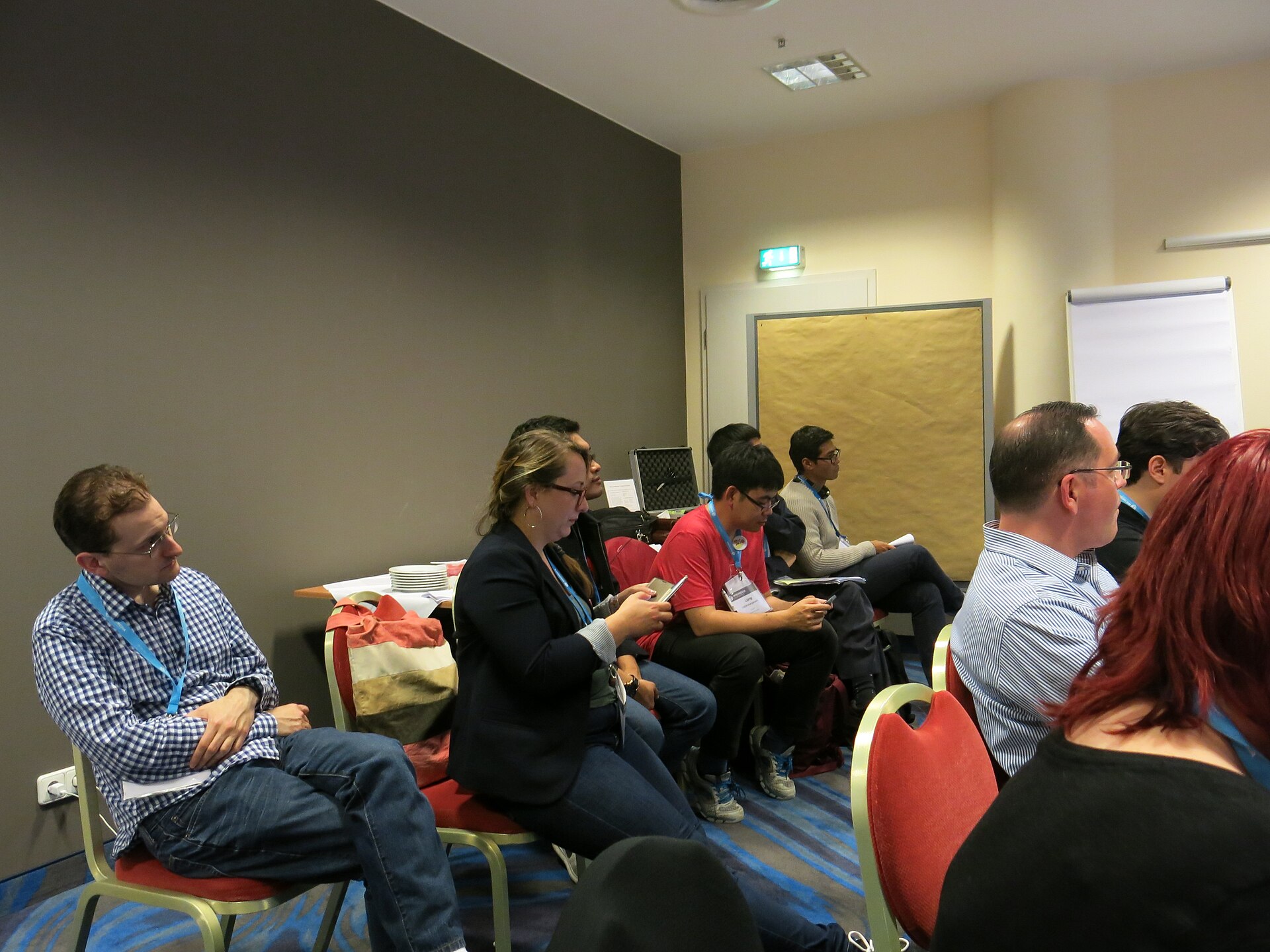
- Dungodung. Hero image: Wikimedia Conference 2017, Learning Days, Education session 3.jpg. Wikimedia Commons · CC BY-SA 4.0.Image source ↗
Related Sanctuary capabilities
From analysis to implementation.
Discussion
No approved comments yet.