
Key findings
- ONS evidence indicates that reported AI use has risen sharply since late 2023, but the average number of AI technologies used by adopting firms has increased only modestly. Adoption is growing faster than operational depth.
- The strongest UK signal is organisational rather than technical: firms with higher management-practice scores were substantially more likely to convert an intention to adopt AI into actual adoption.
- Self-reported productivity improvements are common among AI adopters, yet revenue effects are much less evident and official analysis cautions that robust firm-level evidence of overall productivity gains remains limited.
- For SMEs, the next stage should be a managed change programme: select a bounded workflow, establish controls, train users, redesign the hand-offs around the tool, and measure commercial as well as time-saving outcomes.
The timely issue: adoption is no longer the whole story
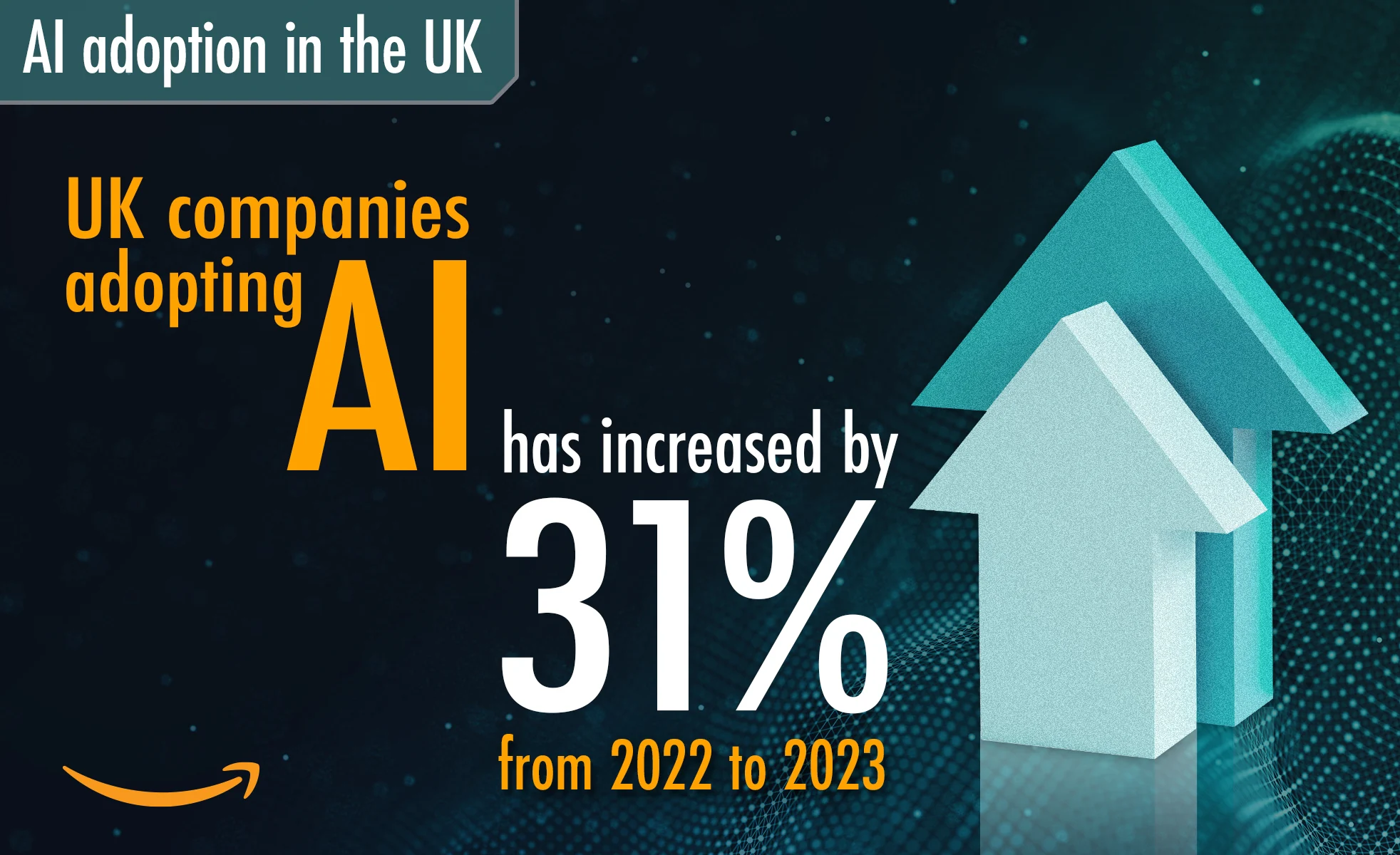
The most recent ONS business snapshot, covering June 2026, finds that the share of UK businesses with 10 or more employees reporting use of at least one AI technology had risen from around 12% in late 2023 to around 35%. Yet the average number of AI technologies used by adopters rose only from around 1.4 to 1.6 over the same period. That combination matters: it suggests a rapid diffusion of initial tools without equivalent evidence of deep operational transformation (Office for National Statistics, 2026) ↗ ([ons.gov.uk](https://www.ons.gov.uk/businessindustryandtrade/business/businessservices/articles/artificialintelligenceinukbusinesses/2023to2026/pdf)).
This is not an argument that UK firms are failing to adopt. It is an argument that leaders, local business-support organisations and policymakers should stop treating a licence purchase, a pilot or occasional employee use as the finish line. In June 2026, ONS found a wide gap between employee-reported AI use for work or education (55%) and business-reported use of at least one AI technology (around 35%). Informal use can be useful, but it can also leave organisations without shared standards for data, quality assurance, customer communication or learning from what works (Office for National Statistics, 2026) ↗ ([ons.gov.uk](https://www.ons.gov.uk/businessindustryandtrade/business/businessservices/articles/artificialintelligenceinukbusinesses/2023to2026/pdf)).
The central question for the UK’s SME economy is therefore changing from ‘Which AI tool should we try?’ to ‘Which work should we redesign, with what safeguards, skills and measures of value?’
What the evidence shows — use is broadening, but integration remains uneven
Different surveys measure different things, so headline adoption rates should not be treated as directly interchangeable. The UK Business Data Survey reports that 41% of businesses handling digitised data used AI for at least one purpose in 2025–26; the comparable figure was 40% for sole traders and 41% for micro businesses, rising to 82% for large businesses. The survey also finds an association between AI use and more developed data practices, although that association does not establish that AI caused those practices or vice versa (Department for Science, Innovation and Technology, 2026) ↗ ([gov.uk](https://www.gov.uk/government/statistics/uk-business-data-survey-2026/uk-business-data-survey-2026)).
The more revealing figure is integration. Among businesses using AI, only 21% said their tools were integrated into existing business systems such as Microsoft 365, CRM, finance or workflow platforms (Department for Science, Innovation and Technology, 2026) ↗ ([gov.uk](https://www.gov.uk/government/statistics/uk-business-data-survey-2026/uk-business-data-survey-2026)). That is a useful warning against equating access to generative AI with a changed operating model.
There are credible reasons for caution about productivity claims. DSIT’s adoption research found that 75% of current adopters reported improved workforce productivity and 57% reported improved processes. However, 77% reported no revenue change since adoption, while 12% reported an increase. These are self-reported outcomes from adopters, not causal estimates of firm performance (Department for Science, Innovation and Technology, 2026) ↗ ([gov.uk](https://www.gov.uk/government/publications/ai-adoption-research/ai-adoption-research)). Government’s labour-market assessment makes the same methodological point: there remains limited robust statistical evidence that AI adoption at firm level has translated into higher overall productivity (Department for Science, Innovation and Technology, 2026) ↗ ([gov.uk](https://www.gov.uk/government/publications/assessment-of-ai-capabilities-and-the-impact-on-the-uk-labour-market/assessment-of-ai-capabilities-and-the-impact-on-the-uk-labour-market)).
This does not invalidate local gains. It means that a business should test them rather than assume them: saved minutes are not the same as released capacity; released capacity is not the same as sales growth; and sales growth is not automatically a better job or a stronger local economy.
Why management capability is the binding constraint
ONS analysis linking management-practice data with business-survey responses provides the clearest UK evidence for an organisational explanation. In 2023, 88% of firms in the highest management-practice decile had adopted at least one advanced technology, compared with 51% in the lowest decile. For firms that expected to adopt AI, 48% of those in the top management-practice decile subsequently did so in 2024, compared with 31% of firms with median scores and 17% in the second-lowest decile (Office for National Statistics, 2025) ↗ ([ons.gov.uk](https://www.ons.gov.uk/economy/economicoutputandproductivity/productivitymeasures/articles/managementpracticesandtheadoptionoftechnologyandartificialintelligenceinukfirms2023/2025-03-24/pdf)).
These findings are associations, not proof that better management alone causes AI adoption. More productive or better-resourced firms may be able to invest in both. But the pattern is consistent with a practical proposition: AI is a general-purpose capability that needs complementary work. That includes setting priorities, defining a use case, documenting a process, deciding who may approve outputs, training people, handling exceptions and reviewing outcomes.
The current barriers reinforce that interpretation. ONS identifies difficulty in identifying use cases, cost and lack of expertise as the main factors delaying adoption. Among firms citing a lack of AI expertise, around 62% reported training or retraining existing staff, compared with around 26% of firms reporting no adoption barriers (Office for National Statistics, 2026) ↗ ([ons.gov.uk](https://www.ons.gov.uk/businessindustryandtrade/business/businessservices/articles/artificialintelligenceinukbusinesses/2023to2026/pdf)). Training, however, should not be reduced to prompt-writing sessions. Staff need to know when an output is reliable enough to use, when escalation is required, how confidential information is handled, and how the work process changes around the tool.
External research supports optimism — and a design discipline
Experimental evidence shows that AI can materially improve performance in particular, well-specified settings. A large field study of customer-support workers found that a generative-AI assistant increased issues resolved per hour by 15% on average, with larger gains for less experienced and lower-skilled workers (Brynjolfsson, Li and Raymond, 2025) ↗ ([academic.oup.com](https://academic.oup.com/qje/article/140/2/889/7990658)). A separate set of randomised field experiments involving 4,867 software developers found a pooled 26.08% increase in completed tasks for developers given access to an AI coding assistant, though results varied across the three experiments (Cui et al., 2026) ↗ ([pubsonline.informs.org](https://pubsonline.informs.org/doi/10.1287/mnsc.2025.00535)).
The interpretation should be precise. These studies are stronger than opinion surveys for their respective tasks, but neither offers a universal productivity number for UK SMEs. Their common lesson is more useful: gains are realised in a defined work context, with a specific tool, a measurable output and a human role that remains accountable for the result. The task, data, workflow, workforce and governance arrangements all matter.
That is why the aspiration to ‘make everyone use AI’ is too blunt. A better goal is to identify a small number of recurring tasks where quality can be checked, the benefit matters commercially or socially, and the organisation can make a deliberate decision about what human judgement must remain in the loop.
Sanctuary interpretation: the SME AI gap may become an execution gap
The risk is not simply a divide between firms that have AI and firms that do not. It is a widening execution gap between organisations able to embed AI into a coherent operating system and those accumulating disconnected tools, informal practices and unmeasured claims of time saved.
For local economies, this matters because smaller firms are not merely miniature versions of large companies. They often have thinner management capacity, less slack for experimentation and greater dependence on a small number of people who hold customer, operational and commercial knowledge. They may nevertheless be well placed to use AI flexibly for customer communications, administration, product development and market research. ONS observes that smaller businesses report more flexible, expansion- or innovation-oriented uses, while larger businesses more often focus on operational efficiency (Office for National Statistics, 2026) ↗ ([ons.gov.uk](https://www.ons.gov.uk/businessindustryandtrade/business/businessservices/articles/artificialintelligenceinukbusinesses/2023to2026/pdf)).
The opportunity is therefore not to copy an enterprise transformation programme. It is to build a proportionate adoption pathway that turns local business knowledge into repeatable, safer and more valuable processes. That perspective complements Sanctuary’s earlier argument that national AI growth should not be mistaken for broadly shared prosperity: diffusion, capability and the quality of work determine who benefits why productivity gains must translate into shared local value.
Sanctuary recommendations: move from tool trials to a 90-day work-redesign cycle
**1. Start with a service or operating problem, not a platform.** Choose one workflow with enough volume to matter: enquiry triage, meeting-to-action conversion, tender first drafts, stock-description production, customer follow-up, knowledge retrieval or basic management reporting. State the baseline in plain terms: time, error rate, response time, conversion, customer satisfaction or backlog.
**2. Map the human hand-offs before automation.** Identify where work begins, what information is needed, where judgement enters, who approves an output and how exceptions are resolved. If the process cannot be explained, AI is likely to amplify inconsistency rather than remove it.
**3. Establish proportionate controls.** Set a short, usable policy covering approved tools, data that must not be entered, review requirements, attribution or disclosure where relevant, and an escalation route for errors. This is operational governance, not a document to be filed and forgotten.
**4. Train around real work.** Run short, supervised practice using the chosen workflow and real but suitably protected examples. Build capability in checking facts, identifying weak outputs, preserving professional judgement and recording reusable prompts or procedures. Managers should participate: their role is to clarify priorities, improve the process and protect time for learning.
**5. Measure value at 30, 60 and 90 days.** Track both immediate measures (time per task, rework, quality checks) and business measures (capacity released, speed to customer, conversion, cost avoided, new service income or staff experience). Stop, adapt or scale based on evidence rather than novelty.
**6. Share learning locally.** Business-support providers, chambers, high-street partnerships and sector networks can make adoption less risky by convening peer demonstrations around comparable use cases. SMEs repeatedly ask for credible examples from organisations like their own; this is an area where trusted local intermediaries can add practical value (Department for Science, Innovation and Technology, 2026) ↗ ([gov.uk](https://www.gov.uk/government/publications/ai-adoption-research/ai-adoption-research)).
This is a management and capability agenda as much as a technology agenda. It is particularly relevant to organisations seeking management consultancy support or practical business-support services to turn an early AI experiment into an accountable operating improvement.
A practical test for leaders
Before committing further spend, leaders can ask five questions:
1. **Value:** Which specific customer, service, cost or capacity problem will this improve?
2. **Workflow:** What will people do differently on Monday morning, and who owns each hand-off?
3. **Assurance:** What must be checked by a person, and what information must not enter the tool?
4. **Capability:** Which employees and managers need practice, guidance and protected time to use it well?
5. **Evidence:** What result, by what date, would justify scaling, changing or stopping the initiative?
If these questions cannot be answered, the constraint is unlikely to be model capability. It is more likely to be organisational readiness. That is a solvable problem — but it requires deliberate management, not another software subscription.
Research foundation
References
- Office for National Statistics (2026). Artificial intelligence in UK businesses: 2023 to 2026. Office for National Statistics.Source ↗
- Office for National Statistics (2025). Management practices and the adoption of technology and artificial intelligence in UK firms: 2023. Office for National Statistics.Source ↗
- Department for Science, Innovation and Technology (2026). UK Business Data Survey 2026. GOV.UK.Source ↗
- Department for Science, Innovation and Technology (2026). AI Adoption Research. GOV.UK.Source ↗
- Department for Science, Innovation and Technology (2026). Assessment of AI capabilities and the impact on the UK labour market. GOV.UK.Source ↗
- Erik Brynjolfsson; Danielle Li; Lindsey Raymond (2025). Generative AI at Work. The Quarterly Journal of Economics, 140(2), 889–942.Source ↗DOI: 10.1093/qje/qjae044
- Kevin Zheyuan Cui; Mert Demirer; Sonia Jaffe; Leon Musolff; Sida Peng; Tobias Salz (2026). The Effects of Generative AI on High-Skilled Work: Evidence from Three Field Experiments with Software Developers. Management Science, 0(0).Source ↗DOI: 10.1287/mnsc.2025.00535
- Sanctuary Consulting & Development Group. Hero image: administrator-supplied photograph. Owner supplied / permission confirmed.Image source ↗
Related Sanctuary capabilities
From analysis to implementation.
Discussion
No approved comments yet.