
Key findings
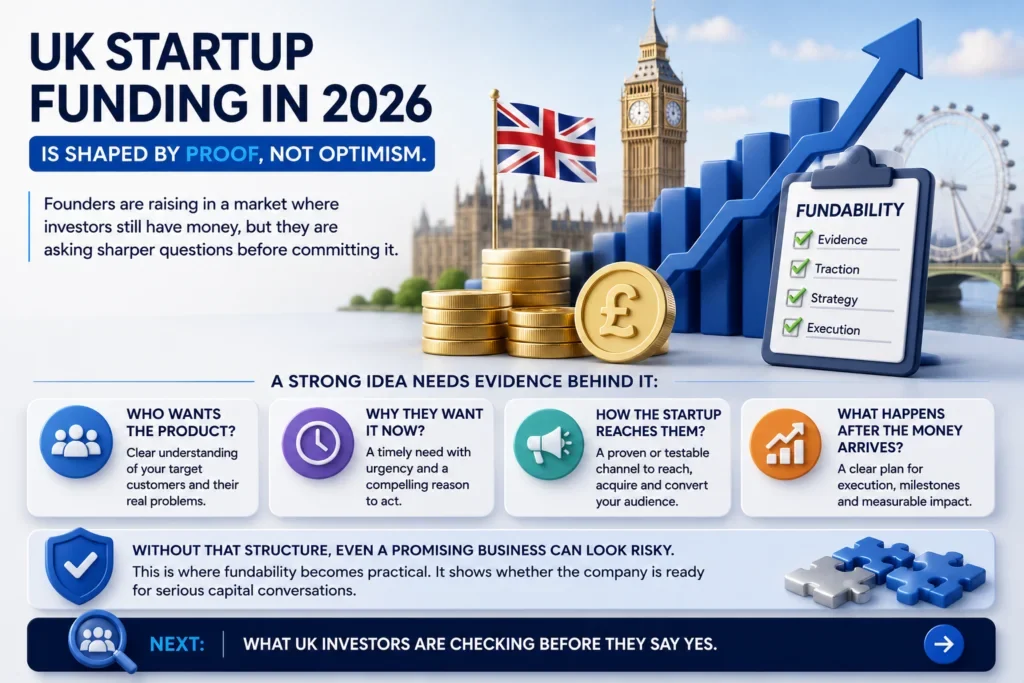
- AI businesses received 44% of UK smaller-business equity investment in 2025, while total investment fell to £12.3 billion and seed- and venture-stage deal numbers declined. This is evidence of concentrated investor appetite, not a complete measure of start-up health (British Business Bank, 2026) [[bbb2026]].
- ONS recorded 317,000 VAT/PAYE-registered business births in 2024 and a 38.4% five-year survival rate for the 2019 cohort. These measures reveal important patterns in registered enterprise, but cannot establish the quality, security or wider reach of entrepreneurship (ONS, 2025) [[onsdemography2025]] [[onsqmi2025]].
- Only 26% of SMEs sought external advice in 2023, falling to 16% among businesses without employees. Poor awareness and a complicated support landscape are reported barriers, making the usability of support as important as its formal availability (Department for Business and Trade, 2025) [[dbtevidence2025]].
- Enterprise policy should distinguish between operating support for the broad business base and growth-and-capital readiness for firms with a substantiated external-finance case.
- A stronger scorecard would track consequential business decisions, trading and employment outcomes, and appropriate finance progression—not investment headlines, applications or attendance alone.
AI investment is a strength, but it answers the wrong question for broad enterprise policy
The UK should welcome its ability to attract substantial investment into AI businesses. It indicates that investors see a group of companies with potentially valuable technology, commercial promise and strategic relevance. At a time when productivity, innovation and the quality of regional employment remain central economic concerns, that capacity matters.
It does not, however, establish that the UK has solved the more fundamental problem of enabling a wide range of people to build viable businesses. Equity investment is a specialised market signal: it shows where investors expect the prospect of exceptional, risk-adjusted returns. It cannot tell us whether a self-employed trader has found repeat customers, whether a local employer can price profitably, or whether an owner-manager has enough cashflow visibility to make a prudent hiring decision.
The distinction is particularly important in the latest data. AI businesses received 44% of UK smaller-business equity investment in 2025 and represented 26% of deals. Yet total smaller-business equity investment fell by 4% to £12.3 billion, seed-stage deal numbers declined by 27%, venture-stage deals fell by 13%, and the ten largest fundraisings accounted for 23% of investment value (British Business Bank, 2026) ↗. A market can therefore be producing highly investable AI companies while becoming less expansive at earlier stages or more concentrated in a relatively small number of large transactions.
That is not an argument against AI investment or against ambitious, equity-backed firms. Concentrated investment may be economically rational where companies have strong technology, large addressable markets or high capital requirements. Nor should policy attempt to make every founder equity-ready. The error is to use a measure of finance for a small subset of scalable firms as a proxy for the health of enterprise across high streets, supply chains, neighbourhood services and smaller employers.
**Sanctuary interpretation.** The UK needs two ambitions at once: to remain competitive in building high-potential AI businesses, and to reduce the practical barriers that stop a much wider business base from testing demand, improving operations and sustaining trade. These ambitions are complementary, but they require different forms of support, finance and accountability.
Business births record entry, not commercial durability
Business-demography data provide a necessary check on both exuberant investment narratives and blanket pessimism. The Office for National Statistics recorded 317,000 business births in 2024, marginally above 316,000 in 2023. Recorded business deaths fell from 310,000 to 280,000, although the latest death figure is provisional. The five-year survival rate for the 2019 birth cohort was 38.4% (ONS, 2025) ↗.
These figures matter because they reveal movement in the registered business population. They should not be made to carry more meaning than their design permits. The ONS series covers enterprises registered for VAT and/or PAYE, rather than every form of self-employment, low-turnover activity or informal trading. It also treats businesses of very different scale within a common administrative frame. The quality guidance is explicit that births, deaths and survival figures have definitional and coverage limits that must inform their interpretation (ONS, 2025) ↗.
A rise in births may be consistent with entrepreneurial confidence or necessity, but it does not demonstrate viable margins, effective management or sustained employment. Similarly, an administrative death cannot by itself explain why a business ceased. Some exits will reflect failure, but others may reflect closure after a planned project, restructuring or a decision to stop an unproductive activity. The 38.4% survival figure is an important cohort statistic, not a universal failure rate or a diagnosis of business quality. It relates specifically to VAT/PAYE-registered enterprises born in 2019, whose first five years included the pandemic.
The practical consequence is that launch should not be treated as the endpoint of enterprise policy. For many smaller firms, the work that makes growth possible is unglamorous: testing a proposition, reviewing prices, managing payment cycles, documenting a process, building a sales routine or deciding not to expand an unprofitable service. These operating disciplines affect whether firms can retain customers, invest with confidence and create durable local economic value.
This is also where the AI-equity narrative and business-demography evidence intersect. A country can simultaneously have world-class technology ventures, a flow of new registered businesses and a substantial group of owner-managed firms that need better commercial foundations. No single headline resolves the condition of that wider system.
The support problem is often usability at the moment of decision
The case for better operating support is not simply a case for adding more schemes. The more basic problem may be whether support is intelligible and useful when a business faces a live decision. The Department for Business and Trade’s evidence annex reports that 26% of SMEs sought external advice in 2023. The proportion fell to 16% among businesses without employees and was 23% among micro businesses. In a cited Growth Hub evaluation, 71% of regional stakeholders identified poor awareness as a barrier to take-up, while 43% of national stakeholders identified a complicated support landscape (Department for Business and Trade, 2025) ↗.
This matters because time and management capacity are scarce in small firms. An owner considering a hire, a tender, a loan, a new software system or a price change may not benefit from another broad directory of provision. They need to identify the decision, understand the evidence required, sequence the next actions and reach specialist help only where it is necessary. Firms with stronger professional networks, more confidence or more spare time are better placed to navigate a fragmented landscape, even where programmes are formally open to all.
The evidence annex also reports an association between use of external advice and higher labour productivity (Department for Business and Trade, 2025) ↗. This is encouraging but not proof that advice itself caused the productivity difference. Businesses that seek advice may already have growth ambitions, resources or management capability that distinguish them from non-users. Advice will only create value where it is relevant, timely and implementable.
**Sanctuary interpretation.** The design principle should be decision-ready support rather than programme-led support. Start with a business problem—whether demand supports a hire, whether a lower price remains sustainable, or whether automation will remove sufficient administration to justify the disruption of change—and then provide proportionate help to act and review the result. This makes management capability a practical economic issue, rather than an abstract training category.
Build two connected tracks rather than a single equity funnel
**Sanctuary recommendation.** Local and national partners should make a clearer distinction between two connected enterprise offers.
**Track one: operating foundations for the broad business base.** This offer should help founders and small employers establish evidence of customer demand, a clear proposition, workable unit economics, pricing and cashflow discipline, sales and delivery routines, people and compliance requirements, and proportionate digital or AI adoption. Its purpose is not to impose corporate process on very small firms. It is to turn an ambition or operational pressure into a short, testable plan.
A practical model would be a diagnostic-led operating sprint that ends with a 90-day plan containing named decisions, measures and review dates. A business might test two customer propositions, prepare a rolling cashflow forecast, document a recurring process before attempting automation, or stop pursuing an unprofitable service line. A disciplined decision not to scale prematurely can be as valuable as a decision to seek new finance.
**Track two: growth and capital readiness for firms with a credible case.** This offer should address market evidence, forecasting, governance, data, intellectual property where relevant, and the fit between the firm and potential finance. Equity should not be the assumed destination. Firms need help to distinguish among grants, debt, patient capital and equity, including the obligations, dilution or repayment risks associated with each.
The tracks should meet at explicit decision gates. A firm with repeatable demand, reliable delivery and a credible financial case may be ready to pursue external capital. A firm without those foundations may need further commercial testing, management support or a pause before taking on obligations that increase risk. This approach protects founders from premature finance-seeking while reducing the chance that genuinely scalable companies remain underprepared.
There is a real trade-off. Tailored support is more costly than generic information and cannot be delivered intensively to every business. Triage is therefore essential: accessible diagnostics and practical tools for the broad base, with deeper support reserved for businesses facing material decisions or showing a credible opportunity to progress.
Measure durable opportunity, not only visible activity
**Sanctuary recommendation.** Investment totals should remain on the dashboard, because they matter for the UK’s innovation economy. But they should sit alongside measures that test whether opportunity is becoming more durable and more widely available.
A balanced scorecard should track: businesses reached by stage, sector and employment status; completion of consequential operating actions such as a pricing review, cashflow forecast or customer-validation test; trading, employment and survival outcomes at 6, 12 and 24 months; and progression into suitable finance, reported separately for grants, debt, patient capital and equity. It should also examine the distribution of outcomes across places and founder circumstances, without allowing participation targets to substitute for meaningful business progress.
The language of attribution must remain disciplined. Outcome data take time to emerge, and small local programmes may not be able to construct robust comparison groups. Where comparison is feasible, it should be used; where it is not, programmes should distinguish clearly between activity, early indicators, observed outcomes and claims of causal impact. This is more demanding than counting applications, event attendance or firms encouraged to pitch, but it is closer to the economic questions that public support is intended to answer.
The aim is not one definition of success. A viable self-employed business, a stable local employer and a venture-scale technology company can each generate value in different ways. The common test is whether policy helps businesses make better-informed decisions, sustain appropriate trading and access finance that fits their circumstances.
The UK’s AI investment strength deserves sustained attention. But it is one component of an enterprise system, not evidence that that system works equally well for every founder. A credible broad start-up strategy will celebrate exceptional investment while doing the less visible work of converting demand, management capability and sound operating decisions into durable economic value.
Research foundation
References
- British Business Bank (2026). AI dominates UK smaller business equity market with record investment share as overall funding falls. British Business Bank.Source ↗
- Office for National Statistics (2025). Business demography, UK: 2024. Office for National Statistics.Source ↗
- Office for National Statistics (2025). Business demography QMI. Office for National Statistics.Source ↗
- Department for Business and Trade (2025). Backing your business: evidence annex. GOV.UK.Source ↗
- Foreign and Commonwealth Office. Hero image: administrator-supplied photograph. CC BY 2.0.Image source ↗
Related Sanctuary capabilities
From analysis to implementation.
Discussion
No approved comments yet.