
Key findings
- The OBR’s March 2026 central forecast expects real GDP growth of 1.1% in 2026 before an average 1.6% a year from 2027 to 2030.
- The Bank of England’s July 2026 outlook still describes spare capacity in the labour market and projects unemployment edging higher in late 2026.
- For SMEs, the correct response is not one macro forecast but trigger-based plans for cash, hiring, price and expansion decisions.
- Scenario planning should specify what evidence causes management to move from one operating posture to another.
The central signal
The OBR’s March 2026 central forecast expects real GDP growth to slow to 1.1% in 2026 before averaging 1.6% a year from 2027 to 2030. It also emphasises a wide range of plausible outcomes around the central case. ↗ The Bank of England’s July report describes spare capacity in the labour market and projected unemployment around 5.0% in Q3 and 5.1% in Q4 2026. ↗
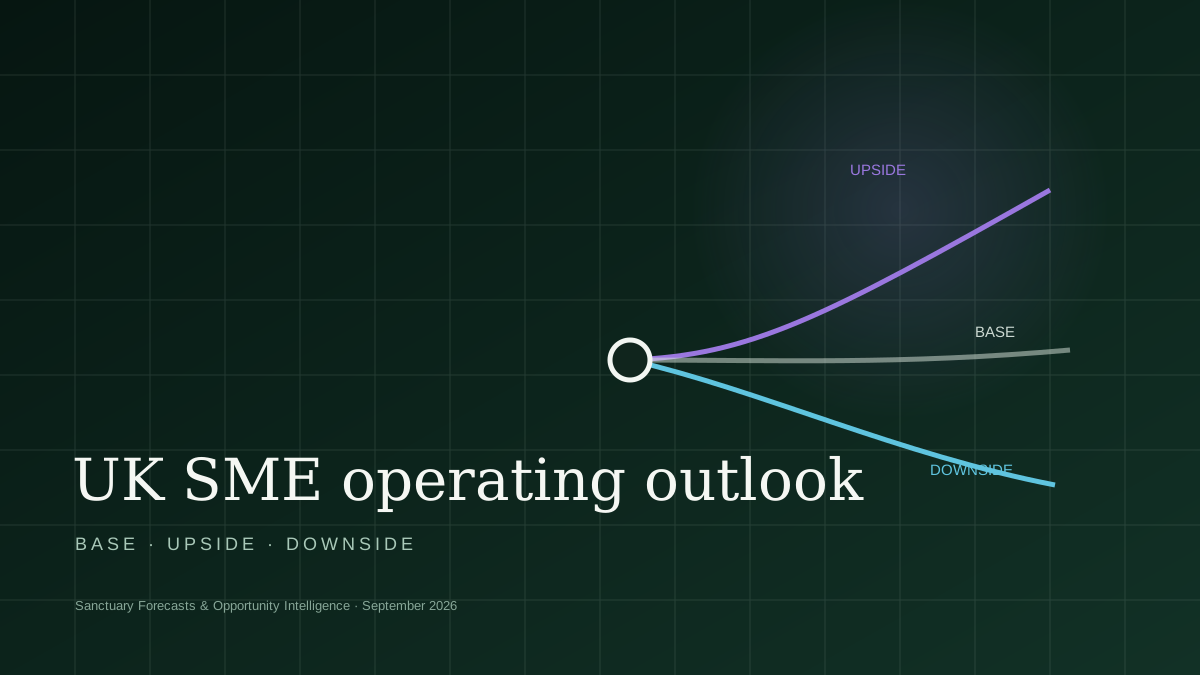
Base scenario: disciplined slow growth
In the base case, demand improves gradually but remains uneven. SMEs should protect cash visibility, make hiring contingent on workload or sales evidence, and favour investments that shorten cycle time or improve customer acquisition. Price increases need a clear value story because customers remain selective. Expansion is possible, but staged commitments are preferable to irreversible fixed cost.
Upside scenario: productivity and demand improve together
The upside case combines stronger productivity, easing uncertainty and better consumer or business demand. The management trigger is not one positive GDP print; it is several reinforcing signals — improving orders, conversion, cash generation and capacity utilisation. In this case, firms that already have repeatable processes and a recruitment pipeline can scale faster than firms that begin planning only after demand arrives.
Downside scenario: weak demand or renewed cost pressure
The downside case is a weaker growth path, renewed energy or geopolitical pressure, or persistently cautious hiring and investment. ↗ The operating response is to shorten forecasting intervals, protect liquidity, prioritise high-contribution products or customers, and defer non-critical fixed commitments. Cutting capability indiscriminately can damage the ability to recover; the objective is resilience, not simply cost reduction.
Use scenarios as operating rules
A useful forecast ends in decisions. Define indicators for demand, margin, cash runway, staffing pressure and customer acquisition; define thresholds; then pre-agree the action attached to each threshold. Sanctuary management consultancy uses this approach to connect uncertain external conditions with concrete operating choices.
Research foundation
References
- Office for Budget Responsibility (2026). Economic and fiscal outlook — March 2026. Office for Budget Responsibility.Source ↗
- Bank of England (2026). Monetary Policy Report — July 2026. Bank of England.Source ↗
- Sanctuary Insights & Research (2026). Sanctuary editorial concept illustration. Sanctuary Consulting & Development Group.Image source ↗
Related Sanctuary capabilities
From analysis to implementation.
Discussion
No approved comments yet.