
Key findings
- Reported UK high-street footfall was 3.8% lower year on year in July 2026, after a 6.2% fall in June; heat was cited as one factor keeping shoppers away.
- Academic evidence shows weather can materially affect retail activity, but the business impact depends on location, format and how the customer journey is designed.
- Climate resilience should be treated as an economic-operating capability for high streets, not only as an environmental programme.
- The practical response is to redesign comfort, shade, timing, mobility, digital touchpoints and mixed-use activity together rather than rely on promotional campaigns alone.
The signal: weather is becoming a commercial variable
British Retail Consortium footfall data reported on 7 August showed UK high-street footfall 3.8% lower year on year in July, following a 6.2% decline in June. London was reported as particularly weak. The same report noted that retail parks performed more strongly, suggesting that accessibility, trip purpose and the physical environment matter alongside consumer confidence (The Guardian, 2026) ↗.
One month does not prove that heat caused every lost visit. Retail demand is affected by income, online substitution, holidays, transport and many other factors. The stronger inference is narrower: extreme weather is now important enough to be included in town-centre operating decisions rather than treated as an occasional disruption.
What research tells us about weather and retail
Rose and Dolega's analysis of retail sales found that weather effects are measurable but uneven across retail contexts (Rose and Dolega, 2022) ↗. Research on six English high streets during the pandemic also demonstrated how footfall can change sharply when the conditions surrounding a visit change, while different centres show different patterns of resilience (Enoch et al., 2022) ↗.
That matters because a high street is not a single store. It is a system of journeys: walking from transport, waiting, browsing, sitting, eating, meeting, moving between businesses and deciding whether the experience is worth repeating. Weather interacts with every one of those stages.
The Sanctuary perspective: resilience is an operating model
A common regeneration response is to add events or marketing when footfall weakens. Those tools can help, but they do not correct an uncomfortable or inflexible environment. Sanctuary's view is that climate resilience should sit inside the commercial operating model of a town centre: how the public realm works, how businesses coordinate, how opening patterns adapt and how customers move between physical and digital touchpoints.
ONS evidence on the long-run changing composition of high streets also supports thinking beyond conventional retail alone: central high streets have seen retail employment decline while accommodation and food services have grown, reinforcing the move towards mixed-purpose centres (ONS, 2026) ↗.
What a climate-resilient high street could do differently
First, map heat exposure at the level where people actually experience it: walking routes, bus stops, uncovered queues, seating and shopfronts. Second, test shaded resting points, planting, drinking-water access and cooler movement corridors where design and maintenance allow. Third, coordinate flexible trading and event times during severe heat rather than assuming the same peak periods. Fourth, help independent businesses connect stock visibility, booking, click-and-collect and local delivery so a lost physical visit does not automatically become a lost local sale.
This is closely related to our high-street regeneration and SME growth work, where the goal is not cosmetic change but stronger local economic performance.
Measure adaptation, not just footfall
Footfall is useful, but it should not be the only success metric. A town-centre climate dashboard could track dwell time, repeat visits, conversion proxies, vacancy, event participation, transport-mode mix and business feedback alongside temperature and weather disruption. The aim is to distinguish a bad weather day from a structural weakness in the place.
This also creates a better evidence base for investment. If an intervention improves comfort but does not improve economic behaviour, it can be changed. If it protects dwell time during heat events, that becomes a measurable economic case rather than a design preference.
From weather response to competitive advantage
The larger opportunity is strategic. A high street that is comfortable, flexible and easy to use in changing conditions may become more attractive relative to less adaptable places. Climate resilience then stops being a compliance cost and becomes part of place competitiveness.
For local authorities, BIDs and landlords, the decision question is not simply 'how do we cool the street?' It is 'how do we protect the whole customer journey as weather becomes less predictable?' That is a more useful starting point for investment and experimentation.
Research foundation
References
- The Guardian (2026). July's heatwaves kept UK shoppers away from high street. The Guardian.Source ↗
- Natalie Rose and Les Dolega (2022). It's the Weather: Quantifying the Impact of Weather on Retail Sales. Applied Spatial Analysis and Policy, 15, 189–214.Source ↗DOI: 10.1007/s12061-021-09397-0
- Marcus Enoch, Fredrik Monsuur, Garyfalia Palaiologou, Mohammed Quddus, Fiona Ellis-Chadwick, Craig Morton and Rod Rayner (2022). When COVID-19 came to town: Measuring the impact of the coronavirus pandemic on footfall on six high streets in England. Environment and Planning B: Urban Analytics and City Science, 49(3), 1091–1111.Source ↗DOI: 10.1177/23998083211048497
- Office for National Statistics (2026). High streets and retail areas in Great Britain: March 2026. ONS.Source ↗
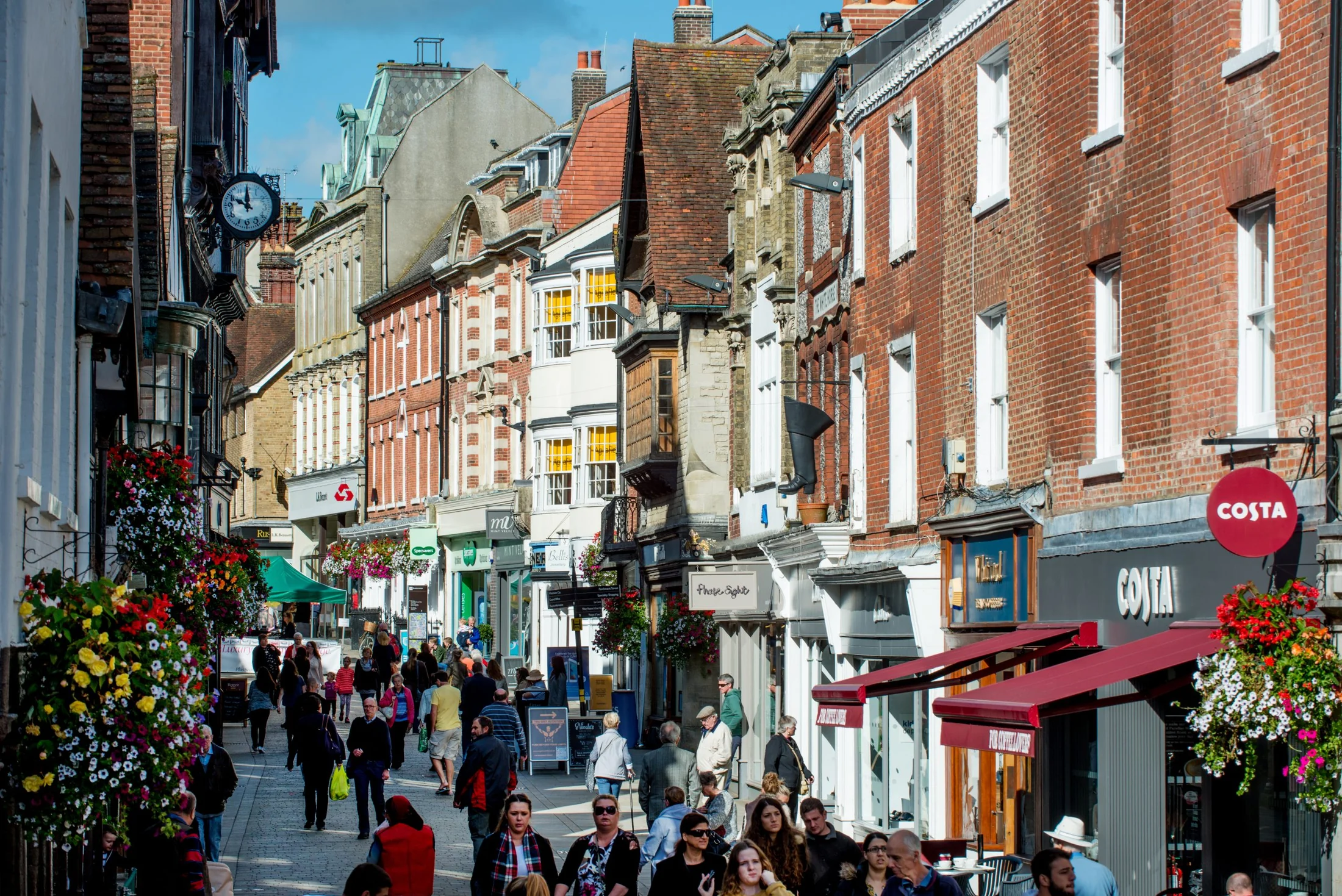
- Sanctuary Consulting & Development Group. Hero image: administrator-supplied photograph. Owner supplied / permission confirmed.Image source ↗
Related Sanctuary capabilities
From analysis to implementation.
Discussion
No approved comments yet.