
Key findings
- Proposed changes announced on 10 August would give councils greater ability to reject new betting and adult gaming premises and require distinct planning control for vape shops.
- Greater control over harmful or over-concentrated uses can be useful, but removing an unwanted use does not create a viable replacement business model.
- Research on the UK experience economy and customer journeys suggests town-centre vitality depends on connected experiences, services and reasons to spend time, not retail volume alone.
- A stronger policy would pair restriction with a pipeline for independent enterprise, social infrastructure, learning, leisure and meanwhile use of vacant premises.
A visible policy response to a visible problem
Plans announced on 10 August would give councils more discretion over new betting shops and adult gaming centres and bring vape shops under more specific planning control. The stated aim is to give communities more influence over the composition and appearance of their high streets (The Guardian, 2026) ↗. The debate also sits alongside wider enforcement against rogue businesses and organised crime on high streets (Home Office, 2026) ↗.
The political attraction is clear: shop mix is visible. Residents can see a cluster of similar uses in a way they cannot see a balance sheet or a lease covenant. But visibility can also produce an overly simple diagnosis.
Restriction and regeneration are different policy instruments
Planning control answers 'what should not open here?' Regeneration must also answer 'what can succeed here instead?' If the underlying economics remain weak — rents, business rates, low demand, fragmented ownership, poor public realm or limited access to finance — a restricted unit can simply become an empty unit.
This is why the policy should be judged on two levels: whether it improves local control and whether it is connected to a credible replacement pipeline. The second part is harder, because it requires entrepreneurship, property coordination and active place management rather than a licensing decision alone.
What research says about the changing high street offer
White and colleagues argue that the experience economy in UK city centres is multidimensional and interconnected rather than a single substitute for retail (White et al., 2023) ↗. AbedRabbo and colleagues similarly show that physical and digital touchpoints across the town-centre customer journey shape patronage (AbedRabbo et al., 2022) ↗.
This points towards a useful principle: the target is not an idealised return to the old retail mix. The target is a healthier portfolio of uses that creates reasons to visit, stay, learn, work, meet, eat, access services and start businesses.
The Sanctuary perspective: manage a portfolio, not a list of shops
A high street should be managed more like an economic portfolio. Some uses produce direct sales, some increase dwell time, some build social trust, some create evening activity and some give early-stage entrepreneurs a low-risk route into trading. The mix matters more than whether every frontage is conventional retail.
That makes place-based high-street regeneration partly an allocation problem: what combination of uses would make this specific centre more useful to its catchment? A policy that only blocks uses is incomplete because it does not answer that question.
A positive-use pipeline
Councils and BIDs could maintain a live register of vacant and soon-to-be-vacant units, identify units suitable for subdivision or meanwhile use, and match them with local entrepreneurs, community enterprises, learning providers and service businesses. Public support should be conditional and experimental: short leases, measurable outcomes, transparent selection and clear exit rules.
The aim is not to subsidise weak businesses indefinitely. It is to reduce the cost of testing uses that the market may not discover quickly on its own. Structured start-up and business planning support can then sit beside property interventions rather than after them.
What success should look like
A successful policy would not be measured by the number of vape or betting shops prevented. It would be measured by healthier vacancy, stronger independent-business survival, more varied reasons to visit, better perceptions of place, and increased economic participation. Health and safety concerns remain valid, including evidence that unhealthy retail exposure is unevenly distributed across places (London Assembly, 2026) ↗.
The central decision is therefore both regulatory and entrepreneurial: give communities more control over uses they do not want, while deliberately building the conditions for useful alternatives to emerge.
Research foundation
References
- The Guardian (2026). Burnham to give councils more powers to block vape and betting shops. The Guardian.Source ↗
- Home Office (2026). New laws to shutdown dodgy high street shops in crime crackdown. GOV.UK.Source ↗
- James T. White, James Hickie, Allison Orr, Cath Jackson and Robert Richardson (2023). The experience economy in UK city centres: A multidimensional and interconnected response to the 'death of the high street'?. Urban Studies, 60(10), 1833–1852.Source ↗DOI: 10.1177/00420980221143043
- Majd AbedRabbo, Cathryn Hart, Fiona Ellis-Chadwick and Zeina Almalak (2022). Towards rebuilding the highstreet: Learning from customers' town centre shopping journeys. Journal of Retailing and Consumer Services, 64, 102772.Source ↗DOI: 10.1016/j.jretconser.2021.102772
- London Assembly Health Committee (2026). Rise of fast-food and vape shops on high streets harms health. London City Hall.Source ↗
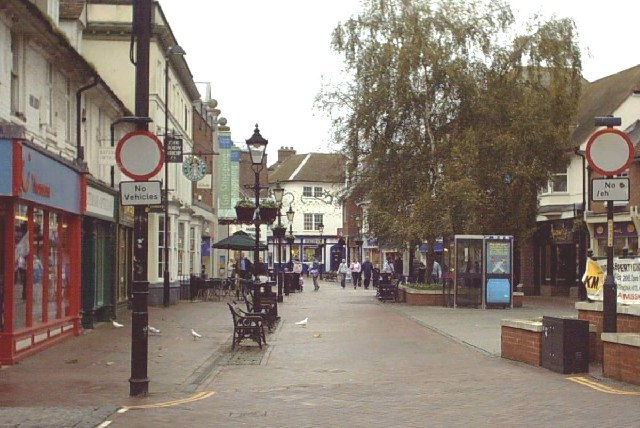
- Adam Colton. Hero image: Ashford Town Centre - Upper High Street - geograph.org.uk - 74845.jpg. Wikimedia Commons · CC BY-SA 2.0.Image source ↗
Related Sanctuary capabilities
From analysis to implementation.
Discussion
No approved comments yet.