
Key findings
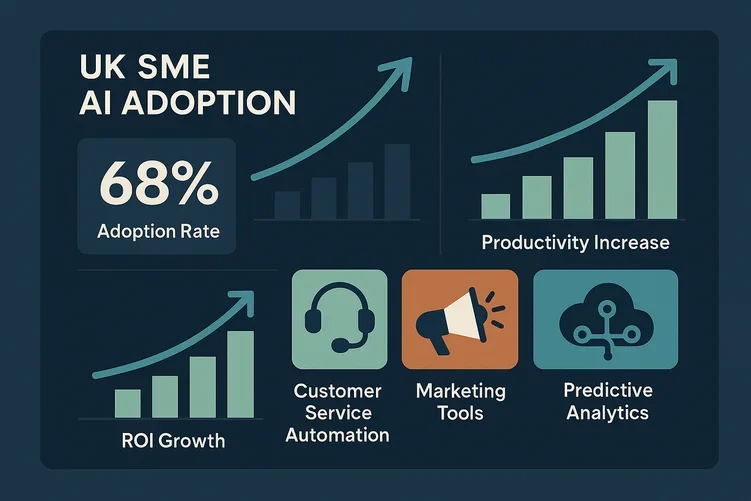
- Reported AI use among UK businesses with 10 or more employees rose from around 12% in late 2023 to around 35% in June 2026. Yet only 10% of AI-using businesses described their use as extensive, so initial uptake should not be mistaken for deep operational integration (Office for National Statistics, 2026) [[onsai2026]].
- Employers invested £53 billion in training in 2024, 10% less in real terms than in 2022 and 19% less than in 2011. The share funding or arranging training also fell from 65% to 59% over that period (Industrial Strategy Advisory Council, 2026) [[isac2026]].
- Among firms planning to adopt AI, subsequent adoption was more common where management-practice scores were stronger. This is a meaningful association, but it does not establish that management quality alone caused adoption or performance gains (Office for National Statistics, 2025) [[onsmanagement2025]].
- Sanctuary’s judgement is that firms should measure AI capability by their ability to improve a defined workflow safely and repeatedly—not by the number of courses bought or tools licensed.
The UK’s AI challenge is conversion, not a race for more courses
The pressing UK question is no longer whether businesses can access AI tools or introductory training. It is whether they can convert those inputs into better work: faster or more reliable processes, improved customer service, stronger decisions, or capacity released for higher-value activity.
That distinction matters because reported AI use has expanded quickly. Around 35% of UK businesses with 10 or more employees reported using at least one AI technology in June 2026, compared with around 12% in late 2023 (Office for National Statistics, 2026) ↗. At the same time, employer training investment stood at £53 billion in 2024—10% below its 2022 level and 19% below its 2011 level in real terms. The proportion of employers funding or arranging training had also fallen, from 65% in 2011 to 59% in 2024 (Industrial Strategy Advisory Council, 2026) ↗.
These figures do not demonstrate that AI is displacing training, or that lower training expenditure is causing shallow AI use. They cover different measures and should not be treated as a single causal series. But together they identify a credible business risk: technology may spread faster than organisations build the managerial and workforce capability required to redesign work around it.
This is particularly consequential for SMEs. In a smaller firm, the people choosing a tool are often also responsible for customer service, operations, staff deployment and cashflow. There may be no separate transformation team to map processes, resolve exceptions or judge whether a pilot has improved the business. The manager is therefore not merely a recipient of training. They are part of the operating infrastructure through which an AI experiment either becomes useful or remains a disconnected subscription.
The policy implication is not that technical learning is unimportant. It is that course volume is an inadequate proxy for capability. The more useful test is whether a business can identify a worthwhile work problem, make a controlled change, involve affected staff and assess the result honestly.
The evidence shows broadening uptake, not proven transformation
The ONS evidence warrants both attention and restraint. AI adoption has risen substantially among the businesses measured, but reported depth of use remains limited. AI-using businesses reported a modest increase in the average number of technologies used, from around 1.4 to 1.6, while 10% described their use as extensive (Office for National Statistics, 2026) ↗. A single application can still produce real value, and “extensive” use is not a productivity measure. Nonetheless, the pattern is a warning against treating a first deployment as evidence of organisation-wide transformation.
Nor can reported uptake answer the questions that matter most to employers and communities. It does not, by itself, show whether service quality improved, whether errors were reduced, whether employees gained useful discretion, or whether financial returns exceeded the cost of implementation. The ONS AI figures cover businesses with 10 or more employees, so they should not be used to describe adoption in the whole microbusiness population (Office for National Statistics, 2026) ↗.
The training evidence also needs careful reading. A decline in recorded expenditure is an important signal of weaker aggregate investment, but it is not a direct measure of learning quality or workplace capability. Lower costs could partly reflect shorter provision, online delivery or other lower-cost forms of learning rather than a simple withdrawal from development (Industrial Strategy Advisory Council, 2026) ↗. Conversely, expenditure can rise without changing how work is organised.
The establishment-level perspective is important here. The 2024 Employer Skills Survey covered more than 72,000 UK employer establishments, underlining that skills needs and implementation conditions are workplace questions as well as individual employability questions (Employer Skills Survey, 2025) ↗. A firm may have access to the same software and courses as a competitor, yet obtain a different result because managers allocate time differently, employees can raise concerns, or quality controls are embedded in the workflow rather than added after the fact.
The evidence therefore supports a narrower conclusion than either AI optimism or AI scepticism. Adoption is spreading; the depth and value of adoption cannot be assumed; and the organisational conditions of implementation deserve as much attention as tool access.
Management is a plausible complementary asset—not a proven sole cause
Management capability is a plausible bottleneck because AI implementation creates work-design decisions. A customer-service lead may need to decide what can be drafted or answered with AI assistance and what must be escalated to a person. An operations manager may need to redesign handovers, set review points and identify exceptions. A finance or commercial lead may need to establish accountable checks for AI-assisted analysis. These are not principally software configuration tasks; they concern objectives, responsibilities, judgement and control.
ONS analysis provides a useful empirical signal. Among firms that had said they planned to adopt AI, 48% of those in the top management-practice decile subsequently adopted it, compared with 31% at the median and 17% in the second-lowest decile (Office for National Statistics, 2025) ↗. The gradient is consistent with a complementary-assets account: firms with stronger management systems may be better able to set priorities, allocate responsibility, monitor progress and resolve implementation problems.
That is not proof of causation. Firms with higher management-practice scores may also have more capital, stronger digital foundations, access to specialist advice or greater capacity to experiment. Management scores may capture some of those wider advantages. The evidence does not show that a management course will generate AI adoption, still less that adoption will raise productivity.
Yet the appropriate response is not to dismiss management as incidental. The association, combined with the practical requirements of changing workflows, supports a more defensible judgement: technology and training are less likely to create value when the responsible manager lacks time, authority or routines to integrate them into everyday work. Management capability should be understood here as the capacity to make and sustain operational changes, rather than as a generic leadership credential.
Why more training spend alone is not the answer
The decline in employer training investment should concern policymakers and employers, but simply restoring expenditure is not a sufficient strategy. Training is an input; operational capability is an outcome. The gap between them is where implementation succeeds or fails.
There is evidence that more productive firms place greater weight on management development. In observable priority sectors, frontier firms were between 5 and 18 percentage points more likely than laggard firms to invest in management training, depending on the sector (Industrial Strategy Advisory Council, 2026) ↗. This does not mean management training explains frontier performance. Productive firms may have resources and systems that make both management development and stronger performance more likely. It does, however, indicate that management development is more commonly treated as part of the operating model among stronger firms, rather than as a discretionary benefit.
The counterargument also deserves recognition. Some AI tools are designed to be useful with limited training and little process redesign. A well-targeted session on safe, role-specific use may deliver a practical improvement quickly. Businesses should not delay every modest use case until they can mount a major transformation programme.
The mistake is to confuse that possibility with a general implementation model. Training can help an employee produce a better first draft, search internal knowledge or prepare a routine response. It cannot by itself determine whether the task is suitable for AI assistance, who owns the final decision, how poor outputs are detected, or how any time saved is used. Those are management choices with trade-offs. Over-standardising a workflow can remove useful staff discretion; pursuing speed without review can shift errors downstream; and expecting staff to learn and implement around an unchanged workload can turn a promising tool into another source of pressure.
For this reason, the most valuable training is often tied to a specific operational change. Technical learning should equip staff to use a tool responsibly. Management development should equip accountable leaders to select the problem, involve the team, set safeguards and make a decision on the evidence.
A Sanctuary approach: controlled work redesign for SMEs
**Sanctuary recommendation.** SMEs should approach AI and skills investment as a controlled work-redesign cycle, rather than a procurement exercise or a catalogue of courses.
**First, select the workflow before selecting the tool.** Identify a process that is high-volume, slow, error-prone or commercially important: for example, proposal preparation, appointment triage, internal knowledge retrieval or routine stock queries. Establish a baseline that reflects the actual problem, such as turnaround time, rework, error rate, customer response, capacity or backlog. A baseline makes it possible to distinguish a useful intervention from novelty.
**Second, give one manager explicit accountability and a realistic mandate.** The accountable manager does not need to become an AI specialist. They do need time to map the current workflow, involve affected employees, define where review is required and escalate concerns. Without this mandate, implementation is often delegated informally to enthusiastic staff while the difficult decisions about responsibility and quality remain unresolved.
**Third, develop managers and staff differently, but jointly.** Staff need practical guidance on appropriate use, a route to report poor outputs and clarity about when to defer to human judgement. Managers need to lead change conversations, interpret exceptions and prevent nominal efficiency gains from becoming unmanaged work intensification. Bringing both groups into the trial improves the chance that local knowledge about customers, edge cases and hidden rework is reflected in the redesigned process.
**Fourth, make an explicit scale, redesign or stop decision.** Compare the trial against its baseline. Assess time or capacity alongside quality, customer outcomes, corrections, escalations and employee confidence. This does not require a complex evaluation unit. It requires a decision discipline: a tool should be extended because it improves a defined workflow on terms the business accepts, not because it is fashionable or has already been licensed.
A practical 90-day version is deliberately modest. In the first 30 days, an employer can create a one-page register of its most troublesome workflows and choose one manageable pilot. From days 31 to 60, it can record outputs, corrections, exceptions and staff feedback. From days 61 to 90, the team can review the evidence and decide whether to scale, redesign or stop. The aim is one credible manager-led improvement, not an artificial organisation-wide rollout.
This discipline also addresses a genuine SME constraint. Cost and staff time away from productive work remain reported barriers to training investment (Industrial Strategy Advisory Council, 2026) ↗. A small, scheduled learning-and-review block attached to a live business problem is more credible than expecting people to reskill around a wholly unchanged workload.
A local economic opportunity lies in reducing implementation friction
The argument has implications beyond individual firms. The Industrial Strategy Advisory Council identifies system complexity, weak coordination, limited collective action and mismatches between provision and employers’ operational needs as interconnected barriers, particularly for SMEs (Industrial Strategy Advisory Council, 2026) ↗. For local business-support organisations, providers, anchor institutions and employer networks, the opportunity is to reduce the transaction costs of implementation—not simply to market more provision.
A useful local offer could help employers identify common workflow problems, find relevant learning, share experience of safeguards and compare implementation approaches with peers. This may be especially valuable for high-street and community-facing businesses, where customer trust, staff capacity and service consistency can matter as much as raw speed. The offer should follow local sector demand and institutional capability rather than assume that one AI programme will suit every place.
The competitive divide will not be determined solely by who buys the most tools or books the most courses. UK evidence does not justify a deterministic claim that AI will widen performance gaps. It does justify close attention to the conditions under which new technology becomes useful. Firms most likely to benefit will be those that connect learning to a defined work problem, give managers capacity to act, involve employees in implementation and evaluate results without self-deception. That is a more credible route to productivity and local economic value than treating training as a stand-alone purchase.
Research foundation
References
- Industrial Strategy Advisory Council (2026). Industrial Strategy Advisory Council: Increasing employer investment in skills. GOV.UK.Source ↗
- Department for Education and Skills England (2025). Employer Skills Survey 2024: UK findings. GOV.UK.Source ↗
- Office for National Statistics (2026). Artificial intelligence in UK businesses: 2023 to 2026. Office for National Statistics.Source ↗
- Office for National Statistics (2025). Management practices and the adoption of technology and artificial intelligence in UK firms: 2023. Office for National Statistics.Source ↗
- Sanctuary Consulting & Development Group. Hero image: administrator-supplied photograph. Owner supplied / permission confirmed.Image source ↗
Related Sanctuary capabilities
From analysis to implementation.
Discussion
No approved comments yet.