
Key findings
- The principal risk for the 2027–29 regeneration cycle is not a lack of announced capital, but a gap between capital delivery and the ongoing capability needed to manage assets, support occupiers and sustain activity.
- Pride in Place’s funding profile makes sequencing consequential: early capital can create visible change, but revenue and governance must be sufficient to convert that change into repeat visits, productive occupancy and maintenance.
- Footfall is a useful leading indicator, not a commercial strategy. Spending power, the strength of the local economy, visitor demand and retail oversupply affect whether more visits translate into viable businesses.
- Access and public-realm schemes should be judged as economic interventions: they must improve the journey, dwell time and trading conditions for a broad range of users while maintaining workable arrangements for servicing and deliveries.
- The strongest local response is a delivery portfolio that combines property activation, enterprise support, access improvements and stewardship, with clear ownership and measurable outcomes.
The thesis: regeneration is moving from allocation to operating capability
**Forecast horizon: late 2026 to September 2029.** UK town-centre policy is entering a more consequential phase than the familiar debate over whether high streets should diversify. A substantial pipeline is moving from plans and allocations towards delivery. The Pride in Place Programme covers 284 communities and is backed by up to £5.8 billion over 10 years; its first 75 places are in delivery, while Phase 2 boards are scheduled to submit plans in late 2026 and early 2027 (Ministry of Housing, Communities and Local Government (MHCLG), 2026) ↗. The Government has also announced £301 million for High Streets Innovation Partnerships, intended to help struggling high streets become more mixed-use centres (MHCLG, 2026) ↗.
The important question is therefore no longer simply whether funding exists. It is whether places can assemble the operating capability to use it well. Capital can improve streets, convert buildings and upgrade market infrastructure. It cannot, by itself, coordinate landlords, recruit and retain independent businesses, manage markets, support community organisations, monitor performance or pay for long-term upkeep. Those functions determine whether a refurbished centre becomes a more useful local economy or merely a better-looking setting for weak demand.
There is reason for qualified confidence, but not for a simple capital-led narrative. The final Towns Fund evaluation found that supported high streets experienced a 6.7% increase in footfall relative to comparator towns, and case-study towns with pride-focused projects recorded a 3.8 percentage-point improvement in pride in place. The evaluation concerns emerging short-term effects from projects completed by May 2025; it does not establish that any individual public-realm scheme will generate durable commercial renewal (MHCLG, 2026) ↗.
**Sanctuary interpretation.** The 2027–29 opportunity is best understood as a test of local operating systems. Places that connect capital projects to access, enterprise, occupancy and stewardship should be better placed to retain benefits. Places that treat these as separate workstreams risk delivering outputs without building the conditions for continued use. This matters now because the period before major expenditure accelerates is the point at which governance, asset control and revenue arrangements can still be designed rather than improvised.
Why the funding profile creates a delivery and stewardship test
Pride in Place’s delivery profile illustrates the sequencing problem. For Phase 1 places, capital funding is £360,000 in 2026/27, £1.736 million in 2027/28, and £1.605 million in each of 2028/29 and 2029/30. Revenue funding is smaller: £231,000 in 2026/27, £256,000 in 2027/28 and £432,000 in 2028/29. Underspends may roll forward, but boards must provide credible forecasts and spend at least 25% of their cumulative allocation in each investment period (MHCLG, 2026) ↗.
This does not mean capital investment is misplaced. Physical improvements can make a centre safer, easier to navigate and more capable of hosting commerce or community activity. The trade-off is that a programme under pressure to demonstrate visible progress may favour projects that are easy to procure over those that solve enduring operational constraints. Paving and lighting are tangible; landlord engagement, local business support, market curation and joint maintenance agreements are slower, less visible and often more institutionally demanding.
Local-government capacity sharpens that risk. The National Audit Office finds that acute service pressures have constrained English local authorities’ ability to invest in prevention, while financial uncertainty has weakened longer-term planning capacity (National Audit Office, 2025) ↗. This evidence is specifically about England and should not be generalised uncritically across the UK. It nevertheless identifies a constraint relevant to many delivery partnerships: regeneration teams may be expected to coordinate complex programmes while their host institutions face severe competing pressures.
**Sanctuary recommendation.** Before capital procurement begins, each board should agree a delivery compact covering five practical questions: who controls the relevant assets; who funds maintenance after grant support ends; who is responsible for activation and occupancy; which local organisations or suppliers can deliver these functions; and how decisions will be made when priorities conflict. This need not delay early action. Delivery guidance permits early expenditure on engagement, voluntary-sector capacity and small capital improvements (MHCLG, 2026) ↗. The better approach is to use quick wins as operational prototypes—for example, testing a managed market model, an accessible route from a transport interchange, or a locally administered vacant-unit programme—rather than treating them as stand-alone cosmetic interventions.
Footfall matters, but the quality of demand determines business viability
A rise in footfall can signal greater vitality, improve trading prospects and strengthen perceptions of safety. It is nevertheless an incomplete account of town-centre recovery. Counts alone do not reveal whether visitors have spending power, whether they stay, whether they return, how they arrive, or whether the businesses present can capture their spending. A centre can be busy at selected times while retaining vacant units, low turnover and an offer poorly matched to its catchment.
Research on 63 UK city centres reinforces this distinction. Centre for Cities found that higher catchment incomes had the strongest association with lower high-street vacancy, followed by the strength of the city-centre economy. Visitor spending and catchment size also mattered, while a 1% increase in average catchment income was associated with a 0.8% fall in vacancy. The analysis also identifies retail oversupply in several weaker centres and finds no relationship between online-retail spending and city-centre vacancy across its sample (Centre for Cities, 2025) ↗.
That finding is a useful corrective to two weak strategies. The first is to blame digital retail alone for local decline. The second is to assume every town should replicate the hospitality-heavy offer of a higher-income visitor city. Neither follows from the evidence. Where spending power or demand is limited, a credible recovery may require a smaller retail footprint alongside services, health, learning, culture, affordable workspace, local markets and community enterprise. The objective is not to maximise the number of retail units; it is to create an offer that residents, workers and visitors can realistically use and sustain.
**Sanctuary interpretation.** Enterprise support should be tied to actual demand and available space, not generic ambitions to support small businesses. For SMEs, this means matching support for start-up, skills and procurement with affordable premises, flexible leases, reliable access and a customer base. For place leaders, it means separating genuinely productive vacancy—space being converted or actively marketed—from persistent vacancy caused by an unviable level of retail floorspace. This is a harder political conversation than promising a full high street, but it is more likely to protect local economic value.
A useful dashboard should therefore combine pedestrian counts by daypart with vacancy by unit size and ownership, business openings and closures, trader retention, transport and interchange performance, car-parking turnover, active-travel access, and the proportion of ground-floor space in productive use. It should be granular enough to show whether an intervention improves a particular street, gateway or market area rather than allowing an area-wide average to hide continued decline.
Public realm and mobility should be treated as access-to-trade interventions
The next funding cycle is likely to intensify investment in streets, safety and public space. The Pride in Place Impact Fund permits interventions including wayfinding, lighting, market infrastructure, footpaths, cycleways, bus-stop shelters and public toilets (MHCLG, 2026) ↗. The Pride in Place Strategy also links town-centre renewal to public-realm improvement and identifies transport funding intended to improve journeys and unlock growth (MHCLG, 2025) ↗.
The economic mechanism is straightforward but conditional: a better journey can reduce the friction of visiting, make a centre usable for more people and encourage visitors to stay longer. Living Streets finds robust evidence that public-realm improvements can contribute to pedestrian footfall or dwell time, while noting that the evidence base is heterogeneous and results depend on local context (Living Streets, 2024) ↗. The implication is not that every pedestrianisation or streetscape scheme will raise spending. It is that access quality is a legitimate economic variable which must be designed and evaluated in place.
This is where polarised arguments about cars versus pedestrians obscure the practical task. A viable town centre needs to work for disabled people, older residents, families, workers with limited time, bus users, cyclists, drivers and delivery operators. Reallocating road space may improve one part of the journey while worsening another if interchange, crossings, loading and servicing are not resolved. Conversely, retaining vehicle access without safe crossings, clear wayfinding or comfortable places to wait may suppress the wider use on which independent businesses depend.
**Sanctuary recommendation.** Treat major public-realm schemes as access-and-trading experiments. Establish a baseline before works start; publish clear arrangements for customers, deliveries and Blue Badge users during construction; measure trips, dwell time, user experience and business conditions after completion; and retain scope to alter loading, parking, seating, market layout or traffic operations. This does not reduce place-making to metrics. It makes the claimed link between public investment, inclusion and local trading testable.
Scenarios for 2027–29: physical delivery is the floor, not the outcome
**Base case: uneven delivery districts.** Phase 1 capital deployment accelerates through 2027/28 as approved Phase 2 plans start to move into delivery. A minority of places connect public realm, vacant-unit activation, enterprise support and stewardship. They are likely to show early gains in visible quality, activity and repeat use. Others complete competent physical schemes but struggle to sustain occupancy or programming. This is the most plausible scenario: the funding pipeline is defined, but institutional capacity and local demand vary considerably (MHCLG, 2026) ↗.
**Upside case: regeneration becomes an access and enterprise programme.** High Streets Innovation Partnerships align with transport, property-owner coordination, business support and local growth priorities. Selected surplus retail space is repurposed for homes, health, learning or workspace; accessible routes and market infrastructure lower barriers to visiting and trading; and local operators gain a viable route into premises or public procurement. The Towns Fund evaluation supports the more limited proposition that focused, visible interventions designed around local need and engagement can improve footfall and pride (MHCLG, 2026) ↗. It does not guarantee the wider economic outcomes, which remain dependent on delivery quality and local demand.
**Downside case: improved streets, weak operating economics.** Procurement and construction proceed, but revenue capacity is fragmented or absorbed by programme administration. Maintenance, place management and business-facing support are not secured after grant funding. In centres with retail oversupply and limited spending power, physical outputs coexist with persistent vacancy and weak occupier confidence. Local financial stress would increase this risk by reducing capacity for the continuing work that capital cannot buy (National Audit Office, 2025; Centre for Cities, 2025) ↗ ↗.
The counterargument is that visible investment can itself restore confidence, attract private interest and create the momentum needed for a stronger operating model. That is possible, and early wins matter. But it is a hypothesis to test, not an assumption to embed in a business case. The key distinction is between an intervention that creates a repeatable mechanism—such as a managed market, a landlord partnership or an accessible visitor route—and one that produces only a one-off uplift in appearance.
What place leaders should decide in the next 12 months
Three developments will show whether this forecast is on track. Phase 2 plan approvals following the November 2026 and February 2027 submission dates will clarify the pipeline of investable projects (MHCLG, 2026) ↗. The choice of High Streets Innovation Partnership locations and delivery arrangements will indicate whether the £301 million commitment is connected to transport, growth and property systems or operates as a discrete programme (MHCLG, 2026) ↗. Finally, early Phase 1 expenditure will reveal whether boards are sequencing quick improvements alongside longer-lead property, infrastructure and service interventions (MHCLG, 2026) ↗.
The forecast should be revised downward if delivery repeatedly stalls over asset control, planning consent, procurement or revenue partnerships; if projects begin without usable baselines for occupancy, footfall or user experience; or if financial pressures erode maintenance and town-centre management. It should be revised upward where small projects demonstrably build repeatable local capabilities: stronger trader retention, viable management of public assets, more productive use of vacant space, or better access for users who previously faced barriers.
**Sanctuary recommendation.** Councils, boards, BIDs and local partners should build a 24-month portfolio rather than a wish list. It should include: first, quick and inclusive access improvements; second, a limited number of property or public-realm projects with confirmed ownership and maintenance responsibilities; third, an enterprise pipeline tied to real units, market spaces and procurement opportunities; and fourth, a shared performance framework focused on use and economic participation as well as appearance.
The central judgement is deliberately practical. The next regeneration cycle can create local value, but only if capital is used to establish the conditions for continued activity. For SMEs, that means a route to affordable, accessible trading space and customers. For councils and delivery bodies, it means management capability is not an administrative afterthought but a core regeneration asset. By 2029, the differentiator between places will be less the visibility of their projects than their ability to keep those projects active, inclusive and economically useful.
Research foundation
References
- Ministry of Housing, Communities and Local Government (2026). Pride in Place Programme: prospectus. GOV.UK.Source ↗
- Ministry of Housing, Communities and Local Government (2026). Pride in Place Programme: delivery guidance. GOV.UK.Source ↗
- Ministry of Housing, Communities and Local Government (2026). High streets revived and children given safe places to play. GOV.UK.Source ↗
- Ministry of Housing, Communities and Local Government (2026). Towns Fund Evaluation: final findings — summary for policymakers. GOV.UK.Source ↗
- Ministry of Housing, Communities and Local Government (2026). Pride in Place Impact Fund: prospectus. GOV.UK.Source ↗
- Ministry of Housing, Communities and Local Government (2025). Pride in Place Strategy. GOV.UK.Source ↗
- Centre for Cities (2025). Checking out: The varying performance of high streets across the country. Centre for Cities, 46 pp..Source ↗
- National Audit Office (2025). Local government financial sustainability. National Audit Office.Source ↗
- Living Streets (2024). The Pedestrian Pound, 3rd edition. Living Streets.Source ↗
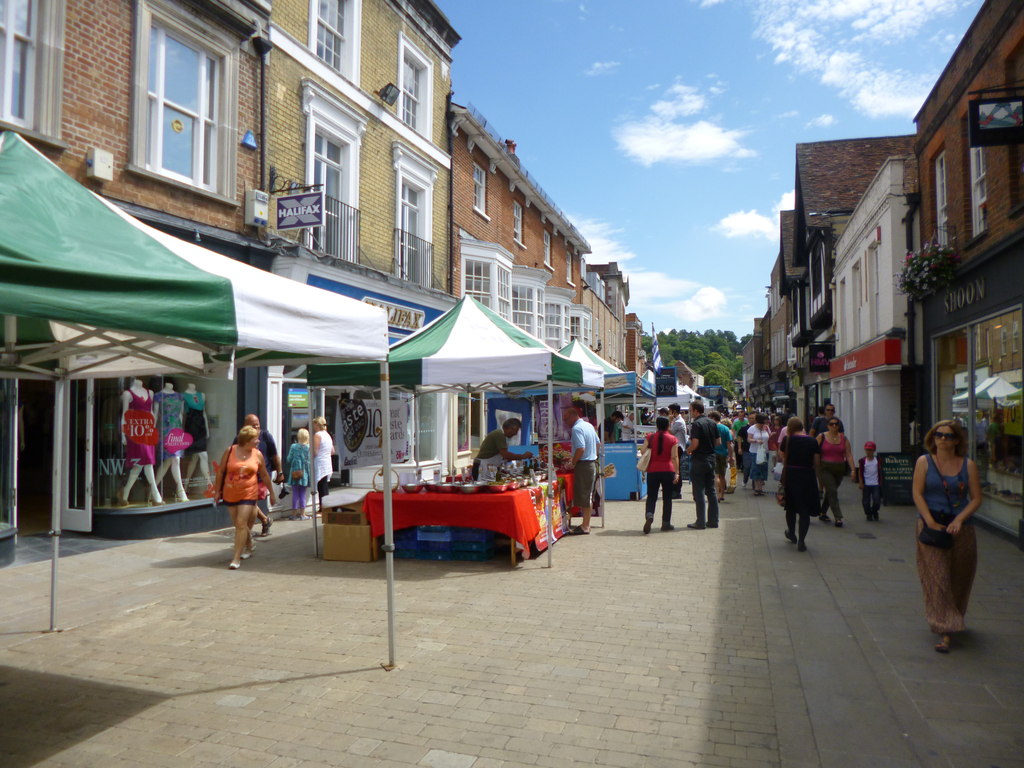
- Mike Faherty. Hero image: Winchester, market stalls - geograph.org.uk - 3569564.jpg. Wikimedia Commons · CC BY-SA 2.0.Image source ↗
Related Sanctuary capabilities
From analysis to implementation.
Discussion
No approved comments yet.