
Key findings
- The near-term shift is institutional as well as physical: grid connections for large loads are moving towards stronger queue discipline and strategic-demand prioritisation.
- Operational data-centre electricity use and connection requests must not be conflated. The gap between them is evidence of optionality in the pipeline, not a forecast of realised demand.
- The strongest projects will combine an evidenced load profile with land control, finance, planning, delivery capability, flexibility where operationally feasible, and a credible locational case.
- Clean-power and network-investment plans improve the outlook for capacity, but they do not remove local constraints or the need to coordinate generation, networks, planning and construction.
- AI infrastructure policy may concentrate investment and demand. Local areas should therefore judge major-load proposals on resilience and local economic value, not only on headline megawatts.
The thesis: connection rights are becoming a test of project quality
Britain’s data-centre and major-load debate is often framed as a simple question of whether the grid has enough power. That misses the more immediate commercial issue. Between 2027 and 2029, the value of a proposed growth site is likely to depend increasingly on whether its electricity demand is credible, deliverable and compatible with the wider system—not simply on whether it has secured a place in a connection queue.
This matters now because network access affects choices already being made on land, design, financing, occupier commitments and local economic strategy. Ofgem’s intervention against speculative data-centre projects, alongside government work to accelerate connections for strategic demand, indicates a policy direction: scarce capacity should be less easily retained by projects that cannot demonstrate a realistic path to delivery. National plans for clean power and network investment point to a system that is expanding, but expansion does not make capacity instantly available at every location. ↗ ↗ ↗ ↗
The Sanctuary view is therefore not that Britain should discourage electricity-intensive investment. Digital infrastructure, advanced industry and electrification can support productivity and regional growth. It is that local authorities, developers and occupiers should treat power as an integrated development problem. A connection agreement is an important milestone; it is not, by itself, a bankable site strategy.
Read the demand numbers correctly: they reveal optionality, not a demand forecast
The available official evidence illustrates why queue position alone is a weak indicator of genuine demand. The Office for National Statistics estimates that operational data centres used 4.5 TWh of electricity in 2024. Separately, Ofgem reports that contracted demand offers rose from 41 GW in November 2024 to 125 GW in June 2025. ↗ ↗
Those figures should not be turned into a simple ratio or a prediction of future electricity consumption. TWh is annual energy used over time; GW is a measure of capacity requested or contracted at a point in time. A large connection request may include headroom for phased build-out, resilience requirements, future tenants or a project that never reaches operation. Its load may also be highly variable. The measures answer different questions.
Even so, the contrast is analytically important. It shows that the pipeline of claimed capacity is much larger than present operational usage, and that a connection portfolio can contain substantial option value. In a constrained system, that optionality has consequences: a speculative or weakly prepared scheme can delay a more mature project, increase uncertainty for network planning and distort how places assess their economic prospects.
Ofgem’s action to tackle speculative data-centre projects should therefore be read as more than an administrative clean-up. It is an attempt to make the connection pipeline better reflect investable, deliverable demand. For investors, the implication is uncomfortable but useful: the commercial premium will increasingly sit with evidence—of customer demand, funding, site control and a feasible delivery timetable—rather than with a nominal reservation of capacity. ↗
How capacity allocation is changing: from order of application towards credible strategic demand
The emerging allocation logic has three linked tests. First is credibility. Ofgem’s focus on speculative projects makes clear that demand claims face greater scrutiny where they appear unlikely to proceed. Second is strategic relevance. The government’s strategic-demand connections work recognises that some large loads have wider policy significance, including their relationship to national economic and infrastructure priorities. Third is system fit: a project must be capable of connecting in a way that can be planned and delivered alongside the network works required. ↗ ↗
This does not mean every data centre, industrial scheme or large warehouse becomes entitled to priority. Nor should it. A broad strategic label without proof of delivery would reproduce the very problem that queue reform is intended to address. The more plausible interpretation is that the evidential burden rises: sponsors need to show why their demand is real, when it will materialise, what infrastructure it requires and why the proposed location is appropriate.
There is evidence of wider progress in the supply-side project pipeline. The National Energy System Operator and electricity networks reported issuing offers to more than half of the energy projects needed by 2030. ↗ That is material, but it is not a guarantee for an individual load project. National progress can coexist with constraints at a particular transmission node, distribution area or construction corridor. The practical unit of analysis remains the site, its timing and its network context.
A connection offer is not the same as an operating asset
The Clean Power 2030 Action Plan and Ofgem’s ED3 framework both point towards substantial system change: more clean generation, stronger networks and investment designed for rising electricity demand. ↗ ↗ The correct conclusion is not that the grid is fixed and growth must be rationed indefinitely. It is that new capacity must be built, financed, consented and coordinated at the right places and times.
For a major-load development, this creates a coordination challenge. Electricity capacity must align with substation and network works, planning, land rights, equipment lead times, cooling design, telecommunications, construction capability and an occupier’s actual ramp-up schedule. A weakness in any one of those elements can undermine the economic value of the rest.
That is why a power-aware site strategy should ask more than, “Do we have an offer?” It should ask: what is the connection timetable conditional on; which delivery dependencies sit outside the developer’s control; how closely does the requested capacity match expected occupancy; and what happens if demand arrives later than planned? These are commercial questions as much as engineering questions. Treating them early should reduce the risk of expensive, oversized or stranded development decisions.
AI policy raises the stakes—but does not remove the delivery discipline
The UK Compute Roadmap and the policy for AI Growth Zones place compute infrastructure within a wider national strategy for AI capability and economic growth. ↗ ↗ That policy attention may help concentrate investment, coordinate public action and make certain locations more attractive to infrastructure sponsors. It may also intensify competition for well-served sites.
The crucial distinction is between strategic intent and physical delivery. An AI-focused designation can improve a location’s proposition, but it cannot by itself provide a completed connection, secure a supply chain, resolve planning questions or ensure that customer demand arrives on schedule. The stronger investment proposition is therefore an AI or compute location that can show how policy support, power, land, delivery and customers reinforce one another.
Resilience should be part of that judgement. Government policy on data centres recognises the importance of the sector’s resilience. ↗ For sponsors and local leaders, resilience is not merely a technical compliance issue. It affects location choice, infrastructure design, contingency planning and confidence in a site’s long-term usefulness. Concentration can create efficiencies, but it can also make the consequences of delay or disruption more significant. A credible growth strategy should be explicit about that trade-off rather than assuming that larger clusters are automatically better.
What credible projects should do now
Sanctuary’s recommendations are practical rather than sector-specific.
First, sponsors should produce an evidence-led demand case. It should distinguish initial load from ultimate build-out, explain the expected operating profile and identify which assumptions depend on signed customers versus market forecasts. A phased request may be more credible than a maximum request that is poorly evidenced.
Second, flexibility should be assessed as a design and commercial option, not treated as a slogan. Where workload, contracts and resilience requirements permit, a project may be able to vary some demand or sequence expansion. Where they do not, sponsors should say so plainly. The objective is a realistic operating plan, not a nominal flexibility promise made only to improve a connection case.
Third, developers should use hard internal stage gates. Land control, planning progress, finance, equipment procurement, construction capability and network milestones should be tested together. This is especially important where a site’s investment case depends on a particular energisation date.
Fourth, local authorities should assess the local economic return alongside the electricity request. Major-load projects can strengthen a place’s tax base, digital ecosystem and skills demand, but those benefits are not automatic. Authorities should seek credible commitments on local procurement, training, supplier engagement and pathways for smaller firms to participate in the resulting ecosystem. For areas with high streets and small-business districts facing their own capacity pressures, the test should be whether a major project supports wider local resilience rather than simply absorbing scarce attention and infrastructure.
Finally, boards need clear governance. Power assumptions should be reviewed alongside leasing, financing and planning assumptions, with named responsibility for dependencies that cut across technical and commercial teams. This is a management-capability issue: sophisticated projects fail when each workstream is individually plausible but their dates and conditions do not join up.
Uncertainty and the counterargument
A tougher approach to speculative requests carries risks. If applied poorly, it could slow legitimate projects, increase administrative burdens or favour sponsors with greater resources rather than better schemes. Equally, the rapid release of capacity that is unlikely to be used can enable investment that would otherwise be delayed. The policy challenge is to distinguish genuine uncertainty—normal in large projects—from low-credibility capacity hoarding. ↗
There is also no basis in the evidence cited here for declaring a single national outcome for data-centre demand, electricity prices or the economic performance of AI Growth Zones. Those outcomes will depend on future technology choices, occupier demand, financing conditions, clean-power delivery and local network constraints. The appropriate approach is scenario-based judgement, not false precision.
In an upside case, clean-power and network programmes progress, mature demand reaches operation and well-prepared sites connect in line with their development plans. In a more difficult case, projects retain ambitious demand assumptions while delivery dependencies slip, leaving capacity, land and capital poorly aligned. The projects most likely to withstand either case are those that have treated power as a disciplined, evidence-backed part of the business model from the outset. ↗ ↗ ↗
The investment judgement for 2027–29
Britain does not face a choice between digital growth and an orderly electricity system. It faces a choice about the quality of projects that secure scarce capacity while the system expands. Queue reform, strategic-demand policy, clean-power planning and network-investment rules all point in the same direction: capacity allocation will reward stronger evidence and better coordination. ↗ ↗ ↗ ↗
For investors and places, the actionable conclusion is straightforward. Do not value a site merely because it has a grid position. Value it according to whether its demand is real, its delivery plan is integrated, its resilience is credible and its economic contribution is broad enough to justify the infrastructure it requires. That is the difference between holding an option on power and building a durable growth asset.
Research foundation
References
- Office for National Statistics (2026). Data centres and the UK National Accounts. Office for National Statistics.Source ↗
- Office of Gas and Electricity Markets (2026). Ofgem acts to free up grid capacity by tackling speculative data centre projects. Ofgem.Source ↗
- Department for Energy Security and Net Zero (2026). Accelerating electricity network connections for strategic demand. GOV.UK.Source ↗
- Department for Energy Security and Net Zero (2025). Clean Power 2030 Action Plan: A new era of clean electricity – main report. GOV.UK.Source ↗
- Office of Gas and Electricity Markets (2026). Ofgem sets rules for 2028 to 2033 grid investment to meet growing electricity demand. Ofgem.Source ↗
- Department for Science, Innovation and Technology (2025). UK Compute Roadmap. GOV.UK.Source ↗
- Department for Science, Innovation and Technology (2025). Delivering AI Growth Zones. GOV.UK.Source ↗
- National Energy System Operator (2026). NESO and electricity networks issue offers to over half of energy projects needed by 2030. National Energy System Operator.Source ↗
- Department for Science, Innovation and Technology (2026). Data centres. GOV.UK.Source ↗
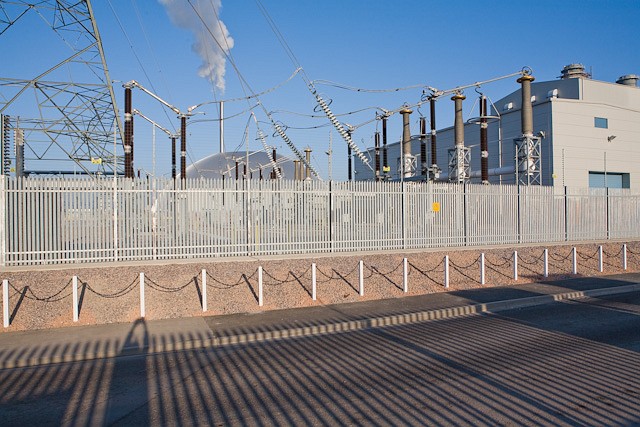
- Peter Facey. Hero image: Marchwood National Grid Substation - geograph.org.uk - 1107752.jpg. Wikimedia Commons · CC BY-SA 2.0.Image source ↗
Related Sanctuary capabilities
From analysis to implementation.
Discussion
No approved comments yet.